
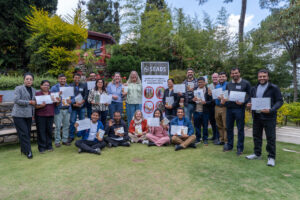
From 6-11 April 2026, the first Asia-based SEADS Training of Trainers (ToT) took place in Nepal, bringing together practitioners from across the region to strengthen how agricultural crises are assessed and addressed.
Funded by the Food and Agriculture Organization of the United Nations (FAO), with additional support from Catholic Relief Services (CRS), the six-day training focused on strengthening technical capacity to design effective, evidence-based responses for farming communities affected by crisis.
“FAO invested in the ToT because common technical standards are essential for all humanitarian agencies. We expect these trainers to spread these standards across Asia,” explained FAO’s Shawn McGuire.
A growing need for effective approaches
Climate shocks, conflict and economic pressures are increasing the frequency and severity of crises worldwide. In many low-income contexts, crop production underpins livelihoods and food security, yet responses targeting crop systems are often under-prioritised or poorly designed.
SEADS aims to address this gap by providing a practical framework to guide decision-making. It supports practitioners in assessing needs, identifying appropriate interventions, and ensuring responses strengthen – rather than disrupt – local agricultural systems and markets.
From standards to practice

This first-of-its-kind training in Asia marks a clear shift from awareness to practical application. Participants were equipped not only to apply SEADS in their own work, but also to train others, helping to scale capacity across organisations and countries.
“It’s critical that governments and decision-makers base their actions on evidence. SEADS helps provide that foundation for more effective responses,” said Adolfo Ruiz, from Samaritan’s Purse in Cambodia.
Participants highlighted the importance of stronger coordination, practical tools for decision-making, and engagement with governments to ensure responses are grounded in evidence and aligned with national systems.
“SEADS brings together practical tools in one place and helps improve coordination between organisations working in emergency contexts,” stated Krishna Mohan Kallapali, from CRS India.
Supporting farmers’ recovery and resilience
For crisis-affected farmers, timely and appropriate support can determine whether they recover or face deeper levels of vulnerability. As climate-related shocks intensify, approaches that move beyond short-term inputs towards sustainable recovery are increasingly critical.
“After floods and landslides, we need to identify timely and appropriate responses. SEADS is helping us do that more effectively, so we can better restore agricultural production and support farmers’ livelihoods,” added Sandipa Khadka, from Nepal’s National Disaster Risk Reduction and Management Authority (NDRRMA).
SEADS promotes responses grounded in local context, supportive of existing seed systems and markets, and linked to longer-term resilience. By strengthening how decisions are made, it contributes to more effective interventions and improved food security outcomes.
Looking ahead
As newly trained facilitators return to their organisations, the next phase of SEADS in Asia is already underway – embedding these standards into programmes, policy and practice across the region, and expanding SEADS training through national and organisational systems.